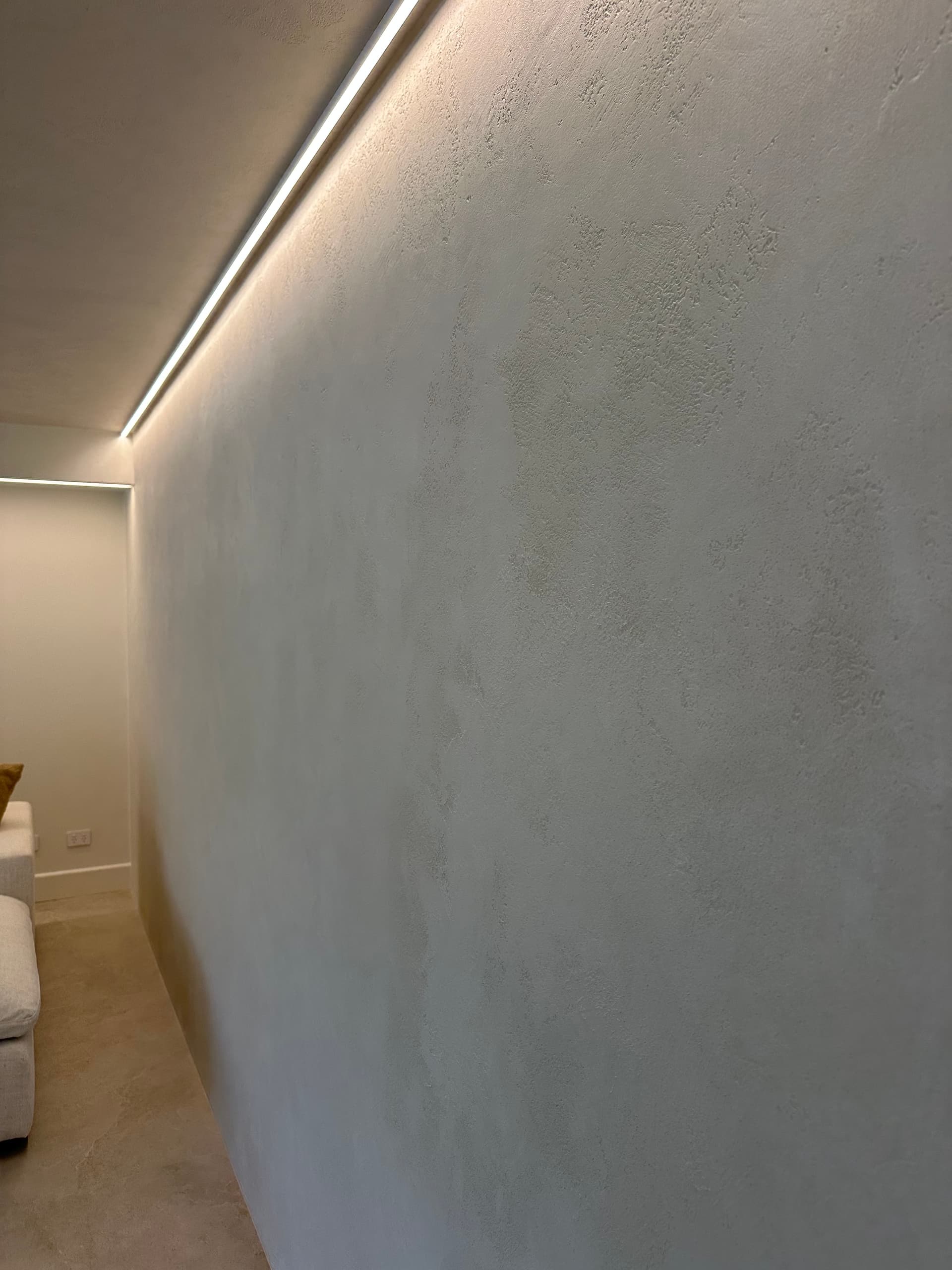
Outdoor kitchens have become one of the most common places clients ask us to use microcement, and it is easy to see why. A benchtop that wraps a barbecue island in one continuous surface, with no grout lines and no visible joins, is difficult to achieve any other way at a sensible cost. Stone slabs need seams and heavy lifting equipment. Tiles bring grout, which outdoors means dirt and mould. Microcement is applied at 2-3mm over the substrate you already have, so it follows the shape of the island and finishes in a single unbroken surface.
It does behave differently outdoors than it does in a bathroom, though. Here is what actually matters.
Heat: the one thing to get right
Microcement is a cement-based coating with a polymer sealer over the top, and it is the sealer that sets the temperature limit, not the microcement. Sealers are not all the same, but as a general rule they do not appreciate sustained direct heat, and that is what an outdoor kitchen throws at a benchtop.
The same applies to a hot pot or pan straight off a side burner. This is not unique to microcement, and it is the same advice we would give for a sealed stone or engineered surface, but outdoor cooking generates more genuinely hot objects than an indoor kitchen does.
UV and colour stability
Direct Australian sun will fade a pigment that was not designed for it. For anything exposed, we use UV-stable pigments and a sealer rated for external use. Where a bench is under a pergola or a patio roof the exposure is much gentler and the choice of colours widens.
One practical note: mid-tone greys and warm neutrals hold their appearance far better outdoors than very dark charcoals. A dark benchtop in full sun gets uncomfortably hot to touch by mid-afternoon and shows any fading more obviously. It is worth seeing a sample in the actual position before committing.
Water, and why the edges matter more than the top
Sealed microcement is waterproof across the surface, which is why it works in showers. Outdoors the risk is not the top face, it is the edges and the junctions: where the bench meets a sink cut-out, where it turns down a waterfall end, and where it abuts a wall or a splashback.
Those are the points that need proper detailing during application and a sealer that has been maintained. Water that gets behind the coating rather than sitting on it is what causes lifting, and that is an application and detailing question rather than a product limitation.
Stains: red wine, oil and marinade
A sealed microcement benchtop resists staining well, but outdoor kitchens are a harder test than most interiors. Oil, marinade, red wine and citrus all get spilled outdoors more often, and they tend to sit for longer before anyone wipes them up.
Wiping spills reasonably promptly handles almost all of it. The exception is oil, which will darken an under-maintained sealer if it is left to soak. Resealing on schedule is what keeps that from happening, and we cover the timing in our guide to [microcement maintenance](/blog/microcement-maintenance).
What we would specify for an outdoor kitchen
- A sound, rigid substrate. Movement is the enemy of a 2-3mm coating. Blockwork or a properly braced frame with compressed sheet, not something that flexes when you lean on it.
- External-grade UV-stable sealer, not the interior specification.
- A heatproof landing area designed in beside the barbecue rather than added later.
- Generous falls away from the house so water leaves the bench rather than pooling at a junction.
- A sample viewed in position, in the light and orientation it will live in.
For heavily exposed benches with no cover at all, [poly microcement](/poly-microcement) is often the better specification. It is more flexible and more forgiving of thermal movement, which is exactly what an uncovered outdoor surface goes through between a 38 degree afternoon and a cold night.
Frequently Asked Questions
Can you put a hot pan directly on a microcement benchtop? No, and we would not recommend it on most sealed surfaces. Use a trivet or a designated heatproof landing area. The microcement itself tolerates heat better than the sealer over it does.
Will a microcement outdoor benchtop crack? Not from the coating itself, but it will follow the substrate underneath. Cracking almost always traces back to movement in the base, which is why the frame or blockwork specification matters more outdoors than it does indoors.
How often does an outdoor microcement benchtop need resealing? More often than an interior surface. Plan on resealing every 1-2 years depending on exposure and use, against 3-5 years for a comparable indoor bench.
Can microcement go over an existing tiled outdoor bench? Usually yes, provided the tiles are sound, well adhered and the substrate does not move. It is one of the main reasons people choose it for a refresh: no demolition and no disposal.
Is it suitable for a bench with no roof over it at all? Yes, with the external specification and UV-stable pigments, and poly microcement is worth considering for fully exposed work. Expect a shorter resealing interval than a covered bench.
If you are planning an outdoor kitchen and want to see how a seamless bench would look in your space, take a look at our [microcement finishes](/microcement) or get in touch for a consultation and a sample in your own light.