
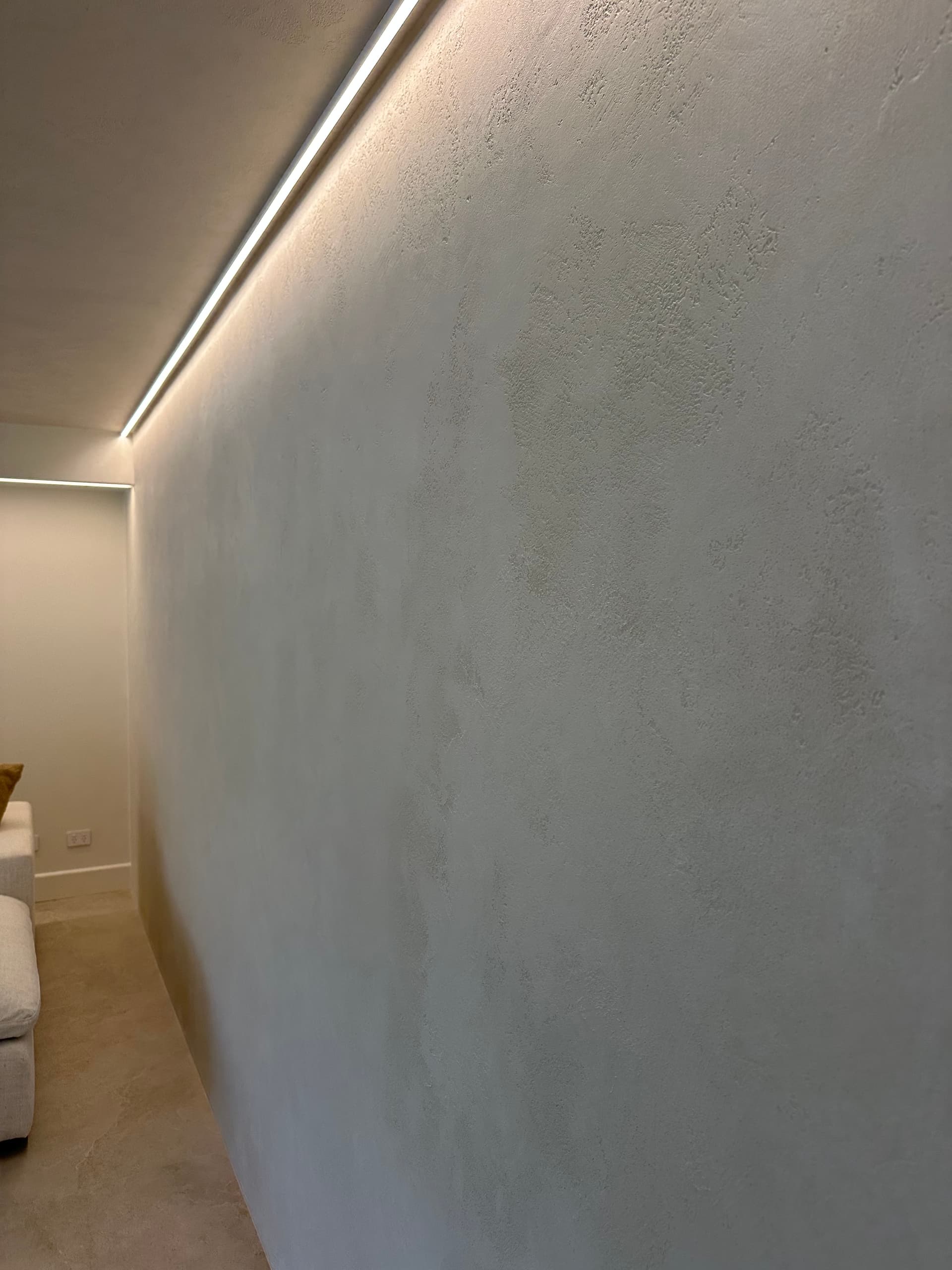
Venetian plaster, also known as stucco lustro or polished plaster, is a wall finishing technique that dates back to ancient Rome. Today it is a sought-after decorative finish for luxury homes and commercial spaces. If you are weighing it up against paint, wallpaper or a feature tile, this guide explains how the finish is made, what it looks like in different rooms, and what to think about before you commit.
How Venetian Plaster Is Made and Applied
The technique involves applying multiple thin layers of plaster made from slaked lime, marble dust, and natural pigments. Each layer is burnished to create a smooth, marble-like surface with remarkable depth and luminosity.
Application is done by hand, usually with a flexible steel trowel. The plasterer spreads each coat thinly in overlapping, crossing strokes, lets it dry, then adds the next. Because the pigment is mixed through the plaster rather than sitting on top of it, the colour has a depth that a single coat of paint cannot reproduce. The final coats are pressed and burnished with the trowel, which is what brings up the sheen.
That hand process is why no two walls look identical. The plasterer's pressure, stroke direction and layering all leave a subtle signature in the finish, which is part of the appeal for people who want something that cannot be bought off a shelf.
Finishes: From Soft Matte to High Gloss
What sets Venetian plaster apart from paint or wallpaper is its ability to reflect light in a way that creates a sense of movement and depth. The finish can range from a subtle matte to a high-gloss polish, depending on the technique used.
Three traditional styles cover most of what people ask for. Marmorino is smooth and marble-like, and suits modern minimalist spaces. Stucco lustro is a high-gloss polish that adds drama to formal rooms. Tonachino is fine-textured and matte, and brings warmth to Mediterranean or coastal interiors.
In practical terms, the choice is usually between a polished finish and a textured one. Polished plaster is smooth and light-reflective, which suits contemporary homes, boutique interiors and commercial feature walls. A textured finish keeps the trowel movement visible and feels more natural and tactile, which suits heritage spaces and earthy, grounded interiors.
Traditional Lime and Modern Formulations
Traditional Venetian plaster is lime-based, which is where its soft, natural character comes from. Modern Venetian plaster products have evolved to include acrylic-modified formulations that offer improved durability and ease of application while maintaining the authentic look and feel of traditional lime-based plasters.
Which one is right depends on the room, the wall behind it and how much wear the surface will see. We work with imported Italian products and recommend a system once we have looked at the space, rather than defaulting to one product for every job.
Where Venetian Plaster Works Well
Common applications include feature walls, entryways, bathrooms, and commercial spaces such as hotels and restaurants. The finish is particularly effective in spaces with good natural lighting, where its reflective qualities can be fully appreciated.
It also suits ceilings, curved walls, stairways, fireplace surrounds, and commercial foyers and display areas, where hand-finished detail makes an impression. If you are choosing a single wall to feature, pick the one where light from a window or fitting skims across the surface. Side light shows the depth of the plaster far more than light shining straight at it.
Bathrooms and powder rooms are possible too, with the right protection. In wet areas a breathable wax or a specialised sealer is applied over the plaster to add water resistance, so it is worth mentioning how the room is used when you ask for a quote.
Preparing the Wall and Looking After the Finish
The wall behind the plaster matters as much as the plaster itself. Venetian plaster can be applied to most wall surfaces, including plasterboard, cement render and existing plaster, as long as the base is smooth and stable. Surfaces are prepared and primed first, and cracks, dents and patches are dealt with beforehand because a polished finish tends to show imperfections underneath it.
Aftercare is simple. A soft dry cloth or gentle dusting handles day-to-day cleaning, and a damp cloth works for deeper cleaning. Avoid abrasive cleaners, which can dull the surface. Minor scuffs and marks can often be repaired by an experienced plasterer without redoing the whole wall.
Frequently Asked Questions
Is Venetian plaster the same as paint?
No. Paint is a film that sits on the surface of the wall, while Venetian plaster is built up from thin, burnished coats of plaster. That layering is what creates the depth and light-reflecting quality that paint does not have.
Can Venetian plaster be used in a bathroom?
Yes, with appropriate protection. A breathable wax or specialised sealer is applied over the plaster in bathrooms and powder rooms to add water resistance. Tell us how the room is used and we will recommend the right approach.
What walls can Venetian plaster go on?
Most wall surfaces, including plasterboard, cement render and existing plaster, provided the surface is smooth and stable. We prepare and prime the wall before the first coat.
How do I clean and repair Venetian plaster?
Use a soft dry cloth or gentle dusting for routine cleaning, and a damp cloth when it needs more. Small marks can often be repaired and blended in without redoing the whole wall, so ask before assuming a full redo is needed.