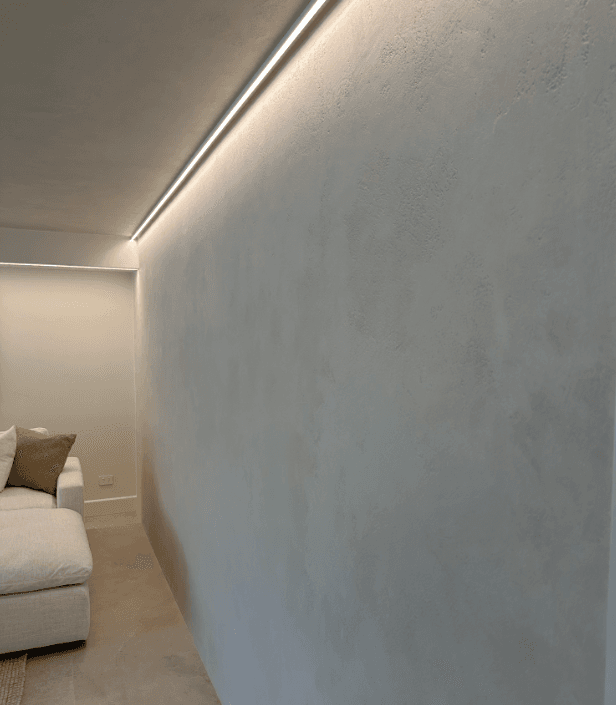

Bathrooms are increasingly becoming spa-like retreats, and microcement is a popular part of that design trend. Its continuous, joint-free finish creates a sense of spaciousness while removing the grout lines that can harbour mould and mildew. This guide covers where microcement works in a bathroom, how to think about colour and finish, and what a renovation involves.
Why Microcement Suits Bathrooms
Most bathroom frustrations come down to grout and joins. Grout discolours, collects soap scum and breaks up the surface with a grid of lines. Microcement is applied as a continuous surface, so there are no grout lines to scrub, and the floor, walls and fixtures can read as one calm space.
Cleaning is simpler too. A continuous surface can be wiped down in one pass rather than worked grout line by grout line, which adds up over the life of a bathroom.
It is a thin coating, around 2-3mm, built up by hand in layers. That lets it follow the shape of the room, including curved walls, rather than forcing everything into tile sizes.
Design Ideas for Every Surface
Shower walls and floors
One of the most popular applications is microcement shower walls and floors. The continuous surface creates a sleek, modern look while providing water resistance when properly sealed. On floors, the finish can include anti-slip additives, so grip does not have to be traded for style.
Vanity tops and splashbacks
Microcement can also be applied to vanity tops and splashbacks, creating a cohesive look throughout the bathroom. The material is durable enough for daily use and can be sealed to resist water and stains.
Bath surrounds, walls and joinery
Bath surrounds, feature walls and built-in joinery can be finished in the same material, which is how designers achieve that wrapped, single-surface look. Carrying one colour across the floor and walls also helps a smaller bathroom feel more spacious.
Planning the details
Decisions such as where the floor falls to the drain, where shelves or niches sit, and whether the surface runs continuously from floor to wall are much easier to settle before the first coat goes on. Talk these through at the site inspection so the finished bathroom works as well as it looks.
Choosing Colour and Finish
Colour options for bathroom microcement are wide. From warm neutrals that create a calming atmosphere to bolder colours that make a statement, the choice is yours, and finishes range from matte to satin.
Bathrooms are lit differently to other rooms, often with a mix of daylight, downlights and mirrors, so a colour can look quite different once it is on the wall. Ask for a sample and look at it in your own bathroom at different times of day before you decide. It is also worth thinking about tapware and fittings, because a finish chosen alongside the metals and ceramics will look deliberate rather than accidental.
Renovating Without Demolition
Microcement can be applied directly over existing tiles, which means many bathrooms can be updated without stripping out the old surface. That saves on demolition, disposal and mess.
The tiles do need to be sound and well adhered. Preparation includes priming, levelling and crack repairs where needed, then thin layers of microcement are trowel-applied, and finally a high-grade sealer is applied for stain and water resistance.
Every bathroom is different, so we begin with a site inspection to assess the existing surface and choose the right microcement system. That is also the time to talk through waterproofing for your particular room.
Keeping Your Microcement Bathroom Looking Good
Maintenance is straightforward: regular cleaning with pH-neutral products and periodic resealing will keep the surface in good condition. The sealer is the protective layer, so avoid abrasive cleaners and acidic products, keep the room ventilated, and wipe or squeegee wet surfaces after showering.
Frequently Asked Questions
Can microcement be applied over my existing bathroom tiles?
In most cases, yes, as long as the tiles are sound and well adhered. We assess the condition of the surface during the site inspection and prepare it before the first coat.
Is microcement waterproof in a shower?
When properly sealed, microcement is water resistant and is used in showers and wet rooms. The sealer and the detailing at junctions matter, so we cover waterproofing for your particular bathroom during the inspection.
Is microcement slippery when wet?
Microcement can be finished with anti-slip additives to provide grip on bathroom floors. Tell us how the space will be used and we can recommend an appropriate finish.
How do I clean a microcement bathroom?
Use a pH-neutral cleaner with a soft cloth or mop, and avoid abrasive or acidic products. Wiping down wet surfaces after showers helps protect the sealer.